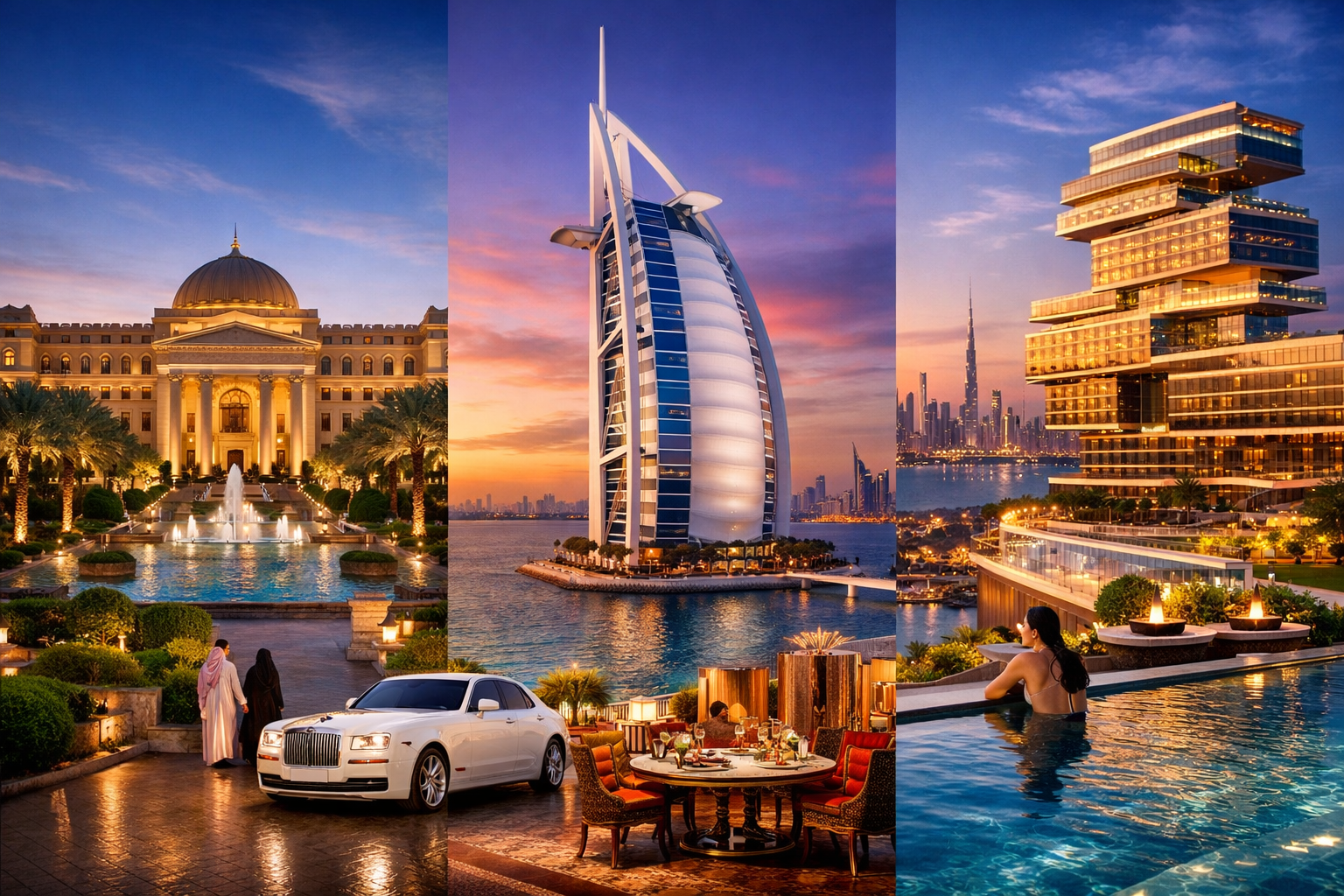
Palaces of Hospitality: A Human Journey Through Three of the Most Luxurious Hotels in Riyadh and Dubai
Luxury in the Middle East has always carried a distinct signature. It is not merely about gold-plated ceilings, crystal chandeliers, or record-breaking architecture. It is about generosity. It is about scale. It is about hospitality rooted in centuries of tradition—where welcoming a guest is not a transaction, but an honor.
In the twin powerhouses of Riyadh and Dubai, luxury hospitality has evolved into something extraordinary. These cities are no longer just financial and political centers; they are stages where ambition meets artistry. Here, hotels are not simply places to stay. They are symbols of national pride, reflections of cultural identity, and immersive experiences that blur the line between fantasy and reality.
Among the many opulent properties that grace these skylines, three stand as defining icons: The Ritz-Carlton, Riyadh; Burj Al Arab Jumeirah, Dubai; and Atlantis The Royal, Dubai. Each offers a different interpretation of luxury. Each tells a story—not just of wealth, but of vision, culture, and human connection.
1. The Ritz-Carlton, Riyadh: A Palace of Quiet Power
If Dubai’s luxury dazzles, Riyadh’s luxury commands. The Ritz-Carlton, Riyadh does not shout for attention—it asserts its presence with dignified grandeur.
Approaching the hotel feels like arriving at a royal estate. Inspired by classical European palaces yet deeply grounded in Arabian sensibility, the property stretches across 52 acres of landscaped gardens. The building’s façade, with its towering columns and arched windows, evokes the kind of architecture designed to endure for centuries.
But beyond its scale lies something more intimate.
A Reflection of Saudi Heritage
Saudi Arabia’s transformation over the past decade has been dramatic. As the Kingdom opens its doors to global tourism, The Ritz-Carlton, Riyadh serves as a bridge between tradition and modernity.
Step into the lobby and the first sensation is space. The ceilings soar high above intricate chandeliers. Marble floors stretch endlessly, reflecting warm golden light. Yet the atmosphere does not feel cold or intimidating. It feels deliberate—like entering a carefully curated sanctuary of elegance.
Arab hospitality, or karam, has always been central to Saudi culture. At The Ritz-Carlton, that spirit lives in the smallest details: Arabic coffee served in delicate cups, dates offered with quiet pride, staff members who greet guests not just with professionalism but with sincerity.
Suites That Feel Like Private Residences
The rooms are not simply luxurious; they are expansive. Many suites resemble private apartments, with separate living areas, plush fabrics, and handcrafted furnishings. The design avoids excess flamboyance. Instead, it leans into classical refinement—cream tones, polished wood, and subtle Saudi motifs woven into carpets and walls.
In a world obsessed with “Instagrammable” spectacle, The Ritz-Carlton offers something rarer: gravitas. The luxury here feels grounded, mature, and assured.
Gardens and Solitude
One of the hotel’s most remarkable features is its outdoor space. Riyadh’s desert climate might suggest harshness, yet the hotel’s landscaped gardens provide lush contrast. Palm-lined pathways, manicured lawns, and serene water features create a tranquil environment that feels worlds away from the bustling capital.
Guests often describe a curious sensation: despite the grandeur, the property feels peaceful. There is room to breathe. Room to reflect.
A Symbol of Saudi Ambition
The Ritz-Carlton has also played host to high-level diplomatic meetings, royal events, and international summits. Its halls have witnessed political negotiations and historic gatherings. In that sense, it is more than a hotel—it is part of Saudi Arabia’s evolving narrative.
Yet what truly defines it is not politics or prestige, but its quiet ability to make guests feel respected.
Luxury here is not about being overwhelmed. It is about being valued.
2. Burj Al Arab Jumeirah, Dubai: The Sail of Imagination
If The Ritz-Carlton represents dignified power, the Burj Al Arab represents audacious imagination.
Shaped like a billowing sail rising from its own artificial island, this hotel has become synonymous with Dubai itself. For many travelers, the silhouette of the Burj Al Arab is the first image that comes to mind when they think of modern Arabian luxury.
Completed in 1999, it was designed to signal Dubai’s arrival on the global stage. And signal it did.
The World’s Only “Seven-Star” Legend
While officially a five-star hotel, the Burj Al Arab has often been described as “seven-star”—a term born from the sheer extravagance it embodied at launch. Whether literal or metaphorical, the label reflects something undeniable: the property redefined global expectations of luxury hospitality.
The moment guests cross the private bridge leading to the island, they enter a world detached from ordinary reality.
An Atrium That Defies Scale
Step inside, and you are confronted with one of the tallest hotel atriums in the world. A cascade of color rises upward: vibrant blues, gold accents, bold reds, and sweeping lines that feel almost theatrical. Glass elevators ascend through the vast interior space, offering panoramic views of the Arabian Gulf.
It is not subtle.
But it is unforgettable.
Dubai has never been a city of restraint. It is a city of ambition, innovation, and spectacle. The Burj Al Arab embodies that spirit unapologetically.
Duplex Suites in the Sky
Every room in the hotel is a duplex suite. No standard rooms. No compromises.
Guests enter through private reception areas before ascending internal staircases to bedrooms above. Floor-to-ceiling windows frame endless sea views. Gold leaf detailing, Hermès amenities, and custom-designed furniture contribute to an atmosphere that feels almost cinematic.
Yet beneath the glamour lies meticulous service. Each suite includes personalized butler service. The staff anticipate needs before they are voiced—a hallmark of true luxury.
Dining Above and Below the Sea
The hotel’s restaurants have become destinations in their own right.
Al Muntaha, suspended high above the sea, offers panoramic views that stretch to Dubai’s skyline. Meanwhile, Al Mahara once featured a floor-to-ceiling aquarium, creating the illusion of dining beneath the ocean.
Here, gastronomy becomes performance art.
More Than Excess
Critics sometimes dismiss the Burj Al Arab as excessive. But excess, in this context, is intentional. It was built to astonish. To challenge perceptions. To declare that Dubai was no longer a desert trading port but a global capital of possibility.
More than two decades later, it remains a symbol of that bold declaration.
It reminds us that sometimes, luxury is about daring to dream without limits.
3. Atlantis The Royal, Dubai: The Future of Opulence
If the Burj Al Arab defined Dubai’s past ambition, Atlantis The Royal defines its future.
Opened in 2023, this architectural marvel rises beside the original Atlantis on Palm Jumeirah. But unlike its predecessor, which evokes mythical grandeur, Atlantis The Royal feels avant-garde—almost otherworldly.
It is not just a hotel. It is an experience engineered to astonish.
Architecture That Breaks the Rules
The building’s stacked-block design appears as though giant glass boxes have been carefully arranged in midair. Sky bridges connect different sections, creating dramatic silhouettes against the horizon.
At night, the structure glows like a futuristic palace.
Where traditional luxury leaned on gold and marble, Atlantis The Royal embraces cutting-edge design, immersive art, and technological sophistication.
Sky Pools and Private Infinity
Perhaps its most talked-about feature is the number of rooms and penthouses equipped with private infinity pools. Suspended high above the city, these pools create the illusion of floating between sky and sea.
The sensation is both intimate and expansive.
Luxury here is not about formality—it is about personal freedom. Guests can swim in privacy while overlooking one of the most iconic coastlines in the world.
Culinary Capital
Atlantis The Royal positions itself as a culinary powerhouse. With restaurants led by globally renowned chefs, the hotel transforms dining into an exploration of world cultures.
Food is not just nourishment here. It is identity. It is storytelling.
From refined Japanese cuisine to contemporary Middle Eastern reinterpretations, every plate reflects the cosmopolitan nature of Dubai itself—a city shaped by more than 200 nationalities living side by side.
The Human Element
Despite its futuristic exterior, what truly defines Atlantis The Royal is how it makes guests feel part of something new.
Dubai thrives on reinvention. It is a city that constantly asks, “What’s next?” This hotel embodies that question. It does not rest on tradition; it challenges it.
Guests often describe their stay as immersive. The lighting, music, scents, and textures are carefully orchestrated to create emotional impact. Every corridor feels like a curated journey.
In this sense, luxury becomes experiential rather than ornamental.
Three Hotels, Three Visions of Luxury
Together, these three hotels illustrate different philosophies of opulence.
- The Ritz-Carlton, Riyadh represents heritage, dignity, and the quiet authority of tradition.
- Burj Al Arab embodies bold imagination and the audacity of a young city determined to astonish.
- Atlantis The Royal reflects innovation, reinvention, and the future-facing energy of modern Dubai.
Yet beneath their architectural differences lies a shared foundation: hospitality rooted in Middle Eastern culture.
Hospitality as Identity
In Riyadh and Dubai, luxury is not purely material. It is relational.
The attentive staff member who remembers your name.
The carefully prepared Arabic coffee offered upon arrival.
The discreet butler who ensures privacy without intrusion.
The concierge who curates personalized experiences.
These gestures transform grand buildings into meaningful experiences.
The Emotional Architecture of Luxury
We often associate luxury with objects—marble floors, crystal chandeliers, infinity pools. But true luxury is emotional.
It is the feeling of security.
The feeling of being valued.
The feeling of stepping outside ordinary life and entering something extraordinary.
In Riyadh, luxury feels grounded in respect and tradition.
In Dubai, it feels adventurous and visionary.
But in both cities, it is deeply human.
The Broader Cultural Context
Saudi Arabia and the United Arab Emirates are undergoing rapid transformation. Vision 2030 in Saudi Arabia aims to diversify the economy and expand tourism. Dubai continues to position itself as a global hub for innovation, trade, and lifestyle.
Luxury hotels are part of this narrative. They are not just commercial enterprises—they are statements.
They signal openness to the world.
They attract global travelers.
They serve as platforms for international dialogue.
And yet, they remain anchored in regional identity.
Arab hospitality has always emphasized generosity. Historically, welcoming travelers across desert landscapes was a matter of survival and honor. Today, that ancient ethic manifests in world-class service.
The setting may have evolved from tents to towers, but the spirit remains.
Conclusion: Beyond Gold and Glass
To visit these hotels is to witness more than architectural brilliance. It is to observe how two cities interpret ambition.
The Ritz-Carlton, Riyadh teaches us that luxury can be dignified and serene.
Burj Al Arab reminds us that bold dreams can reshape skylines.
Atlantis The Royal invites us to imagine what tomorrow might look like.
But perhaps the most important lesson is this:
Luxury is not about excess alone. It is about intention.
It is about crafting spaces where people feel seen, respected, and inspired.
In Riyadh and Dubai, hotels have become modern palaces—not just for royalty, but for anyone seeking an extraordinary experience. They are monuments to possibility. They are celebrations of culture. They are sanctuaries of comfort amid rapidly changing cities.
And in their marble halls, under their glittering chandeliers, and beside their infinity pools suspended above the sea, one discovers that true luxury is not measured in stars.
It is measured in moments.