Dubai is often described in superlatives. The tallest. The biggest. The most extravagant. Rising from the desert like a mirage sculpted in steel and glass, the city has become a global symbol of ambition without limits. Yet beyond the headlines and shimmering skylines lies something more intimate: a deeply human desire to create experiences that astonish, comfort, and inspire.
Luxury in Dubai is not only about gold leaf ceilings or panoramic suites suspended in the clouds. It is about storytelling. It is about how architecture shapes emotion, how service anticipates unspoken needs, and how spaces make guests feel both small in the presence of grandeur and profoundly cared for at the same time.
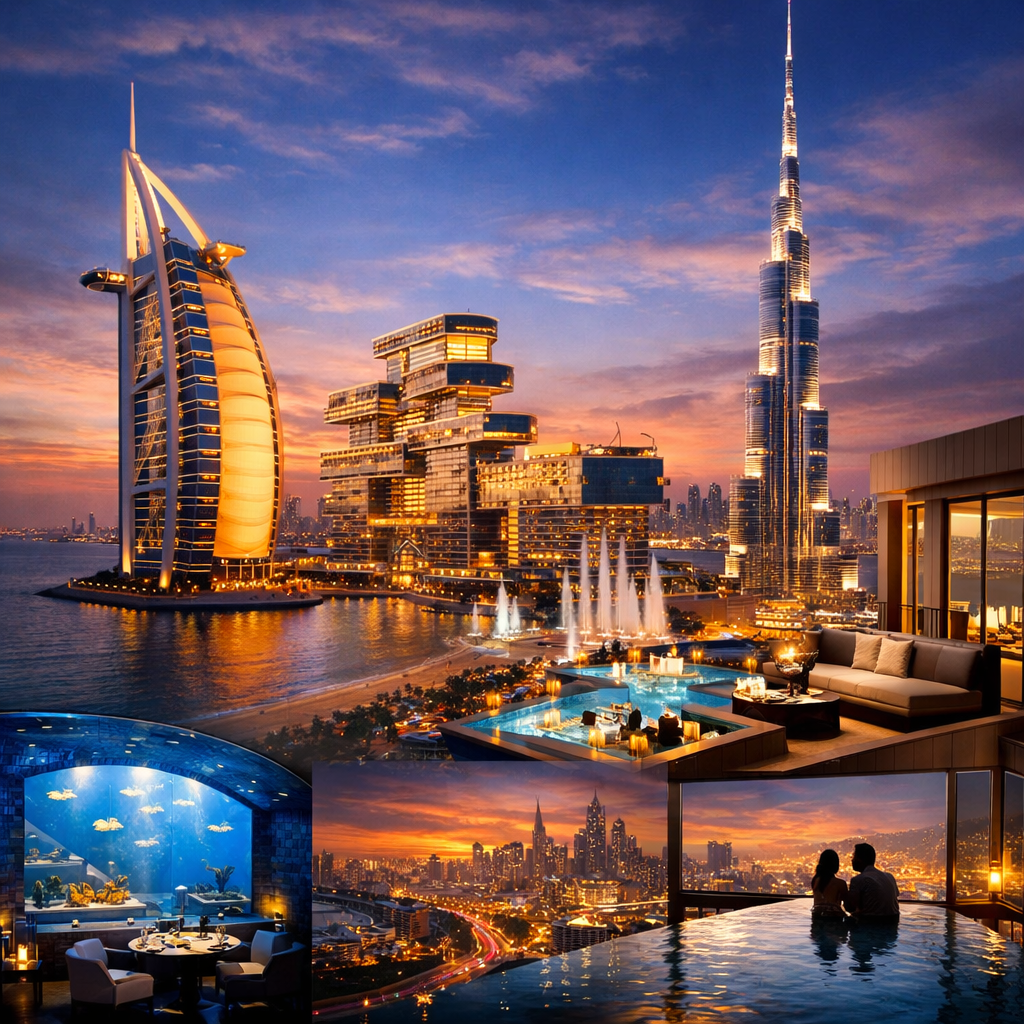
Among the many extraordinary hotels in this city, three stand as icons of modern hospitality: Burj Al Arab Jumeirah, Atlantis The Royal, and Armani Hotel Dubai. Each represents a different interpretation of luxury. Each tells a different story about how human creativity transforms hospitality into art.
1. Burj Al Arab Jumeirah: The Dream That Redefined Luxury
When people first see the Burj Al Arab rising from its private island, they often pause. Designed to resemble the sail of a traditional Arabian dhow, it appears to float above the Arabian Gulf. It is not simply a building; it is a statement. Since its opening in 1999, the Burj Al Arab has become one of the most recognizable hotels in the world—and perhaps the most symbolic of Dubai’s audacious spirit.
Architecture as Identity
The Burj Al Arab was never meant to blend in. Standing over 320 meters tall, it dominates the coastline. Yet what makes it remarkable is not only its height, but its intention. The sail-shaped design honors the maritime heritage of the UAE, connecting modern ambition to historical roots. In a city racing toward the future, the hotel quietly nods to the past.
Inside, the scale shifts from architectural drama to theatrical opulence. A vast atrium—one of the tallest in the world—welcomes guests in a kaleidoscope of color, marble, and gold accents. The interiors are unapologetically bold. Royal blues, deep reds, gilded columns, and intricate patterns evoke a kind of contemporary Arabian palace.
Some might call it extravagant. Others might call it excessive. But there is something deeply human in its design: it dares to imagine without restraint. It invites guests to step into a world where imagination has no ceiling.
Suites That Feel Like Personal Kingdoms
The Burj Al Arab is an all-suite hotel. Each accommodation is a duplex, meaning guests experience two levels of private space connected by a sweeping staircase. Floor-to-ceiling windows frame the sea, allowing sunlight to flood in by day and the shimmer of city lights to glow by night.
What distinguishes these suites is not only their size, but their choreography. Bedrooms are positioned to capture sunrise over the Gulf. Living areas encourage gathering and conversation. Bathrooms, clad in marble, are designed to feel like sanctuaries.
There is something quietly powerful about entering a space that seems designed around your comfort. You are not just renting a room. You are stepping into a temporary home crafted for indulgence.
Service as a Philosophy
Luxury can be measured in thread counts and square meters, but true hospitality is measured in attention.
The Burj Al Arab is known for its fleet of Rolls-Royce transfers and even helicopter arrivals, yet what guests often remember most is the personal butler service. Each suite is assigned a dedicated butler trained to anticipate needs before they are spoken.
This is where the hotel transcends spectacle. The staff learn names. They remember preferences. They notice details. In a place built to impress, they focus on connection.
For many visitors, staying at the Burj Al Arab is not about showing the world where they are. It is about experiencing what it feels like to be cared for with absolute intention.
Dining Above and Below the Sea
The hotel’s restaurants extend the theatricality. Al Mahara, once famous for its dramatic aquarium centerpiece, immerses diners in an underwater fantasy. Al Muntaha, perched high above the Gulf, offers panoramic views that stretch beyond the horizon.
Dining here is not simply about food. It is about atmosphere, perspective, and memory. A meal becomes a moment suspended between sea and sky.
The Emotional Impact
The Burj Al Arab represents a certain era of Dubai—bold, unapologetic, eager to show the world what was possible. Yet beneath its gold and grandeur lies a more universal story: humanity’s fascination with creating monuments to aspiration.
It is a place that makes guests feel larger than life, if only for a few days. And in that feeling—of possibility, of abundance, of being celebrated—there is something profoundly human.
2. Atlantis The Royal: Where Innovation Meets Imagination
If the Burj Al Arab represents the dream that launched Dubai into global consciousness, Atlantis The Royal represents its evolution. Opened in 2023, this architectural marvel sits beside its iconic sibling, Atlantis The Palm, yet announces itself as something entirely new.
With its stacked, geometric silhouette and sky-high infinity pools, Atlantis The Royal is less about nostalgia and more about the future.
A Vertical Village of Wonder
Designed by Kohn Pedersen Fox Associates, the structure appears like a series of interlocking blocks stacked dramatically toward the sky. This unconventional form creates terraces, private pools, and open spaces that challenge traditional hotel design.
Rather than a single towering form, the hotel feels like a vertical village. Spaces are layered. Gardens and water features appear unexpectedly. From certain angles, it resembles a futuristic city carved from glass and stone.
It is bold—but in a different way than the Burj Al Arab. Instead of theatrical opulence, Atlantis The Royal emphasizes architectural innovation and spatial experience.
Rooms That Blur the Line Between Indoors and Outdoors
Many of the hotel’s suites feature private infinity pools suspended high above the Palm Jumeirah. Imagine stepping from your bedroom into warm water, gazing across the Arabian Gulf, with the skyline stretching into the distance.
These spaces blur boundaries. Glass walls dissolve separation between interior comfort and exterior vastness. The design encourages reflection—both literal and emotional.
There is something deeply intimate about floating above a city. From that height, noise softens. Time slows. Perspective shifts.
Culinary Theater
Atlantis The Royal has positioned itself as a global culinary destination. With restaurants led by internationally acclaimed chefs, dining becomes a journey across continents.
From refined Mediterranean flavors to elevated Japanese cuisine, each venue is designed as an immersive environment. Lighting, acoustics, and layout are carefully curated to shape mood.
But what makes the dining scene here particularly human is its diversity. The hotel recognizes that luxury travelers are no longer satisfied with uniformity. They crave discovery. They want stories behind dishes. They want connection to culture.
In this way, Atlantis The Royal feels like a crossroads—where global tastes meet under one roof.
The Sky Pool: A Shared Moment
One of the hotel’s most talked-about features is the Cloud 22 sky pool. Suspended high above the Palm, it offers panoramic views that seem almost surreal.
Yet beyond the Instagram-worthy angles lies a shared human experience. Guests gather at the water’s edge, watching sunsets together. Conversations begin between strangers. Music drifts across the terrace.
Luxury here is not isolation—it is curated community. It is about feeling part of something elevated and vibrant.
A New Definition of Grandeur
Atlantis The Royal does not rely on gold or historical motifs to signal prestige. Instead, it communicates through scale, design, and experience.
It represents a younger, more experimental Dubai—one that is comfortable blending art, technology, and hospitality. It feels less like a palace and more like a visionary playground.
And yet, at its core, it remains focused on human pleasure: comfort, beauty, flavor, sensation. It reminds us that innovation, when done thoughtfully, can feel warm rather than cold.
3. Armani Hotel Dubai: Minimalism as a Form of Luxury
While the Burj Al Arab dazzles and Atlantis The Royal astonishes, Armani Hotel Dubai offers something quieter—but no less powerful.
Located within the iconic Burj Khalifa, the tallest building in the world, this hotel reflects the aesthetic philosophy of its founder, Giorgio Armani. Here, luxury is expressed through restraint.
An Intimate Refuge in a Global Icon
The Burj Khalifa itself is a symbol of ambition. Yet stepping into the Armani Hotel feels like entering a calm oasis within that ambition.
The design palette is muted—earth tones, soft lighting, clean lines. Textures are rich but understated. The atmosphere is serene.
In a city known for spectacle, the Armani Hotel offers subtlety. It whispers rather than shouts.
The Human Need for Calm
Luxury does not always mean excess. Sometimes, true indulgence is simplicity.
Rooms are meticulously designed with custom furnishings and thoughtful layouts. Nothing feels accidental. Every detail, from the lighting controls to the placement of seating, is intentional.
Guests often describe a sense of peace here. The noise of the outside world fades. The city remains visible through the windows, but inside, there is stillness.
In this stillness, one finds a different kind of wealth: space to think, to breathe, to reconnect.
Dining as Design
The hotel’s restaurants reflect Armani’s global perspective. Italian elegance, Japanese precision, Indian warmth—all presented with refined minimalism.
Even the presentation of dishes aligns with the hotel’s aesthetic philosophy. Plates are curated like fashion collections—balanced, intentional, expressive.
There is a certain intimacy in dining here. Lighting is soft. Conversations are hushed. Time feels elastic.
Service Without Spectacle
Service at the Armani Hotel is highly personalized, yet discreet. Staff move quietly, anticipating needs without drawing attention.
This approach speaks to a different understanding of luxury. It is not about dramatic gestures, but about seamless experience.
Guests feel respected. Their privacy is honored. Their comfort is prioritized.
A Reflection of Modern Elegance
The Armani Hotel represents a mature form of luxury—one that recognizes that not all travelers seek extravagance. Some seek refinement. Some seek harmony.
In a city that often celebrates boldness, this hotel reminds us that elegance can be equally powerful.
Three Visions, One City
What unites these three hotels is not simply their price point or their reputation. It is their commitment to crafting experiences that transcend accommodation.
- Burj Al Arab embodies ambition and spectacle.
- Atlantis The Royal represents innovation and experiential design.
- Armani Hotel Dubai offers minimalism and refined calm.
Each reflects a different emotional landscape.
Dubai itself is a city of contrasts—desert and sea, tradition and futurism, intimacy and scale. These hotels mirror that diversity. They are not interchangeable. They are personalities.
The Human Side of Extravagance
Luxury is often misunderstood. It is easy to see only the marble floors or the private pools. But beneath the surface, luxury hospitality is about understanding human psychology.
It is about recognizing that travelers seek more than shelter. They seek transformation.
In the Burj Al Arab, guests feel celebrated.
In Atlantis The Royal, they feel exhilarated.
In the Armani Hotel, they feel grounded.
Each property taps into different emotional desires.
Perhaps that is why Dubai has become synonymous with hospitality excellence. The city understands that architecture alone is not enough. True luxury must connect to emotion.
A Final Reflection
Standing on the shores of the Arabian Gulf at sunset, watching the skyline shift from gold to violet, one realizes that Dubai’s greatest achievement is not its height or its extravagance.
It is its ability to imagine boldly—and to invite the world into that imagination.
The Burj Al Arab, Atlantis The Royal, and Armani Hotel Dubai are not merely places to stay. They are experiences shaped by vision, design, and human care.
They remind us that luxury, at its best, is not about distance from reality. It is about elevating reality—turning ordinary days into unforgettable chapters.
And perhaps that is the true meaning of extravagance: not excess for its own sake, but the creation of moments so thoughtfully crafted that they linger long after checkout.
In a city born from desert sands, these three hotels stand as monuments not just to wealth, but to possibility.
And in every polished marble surface, every infinity pool reflecting the sky, every carefully prepared dish, there is a simple human message:
We dreamed this for you.