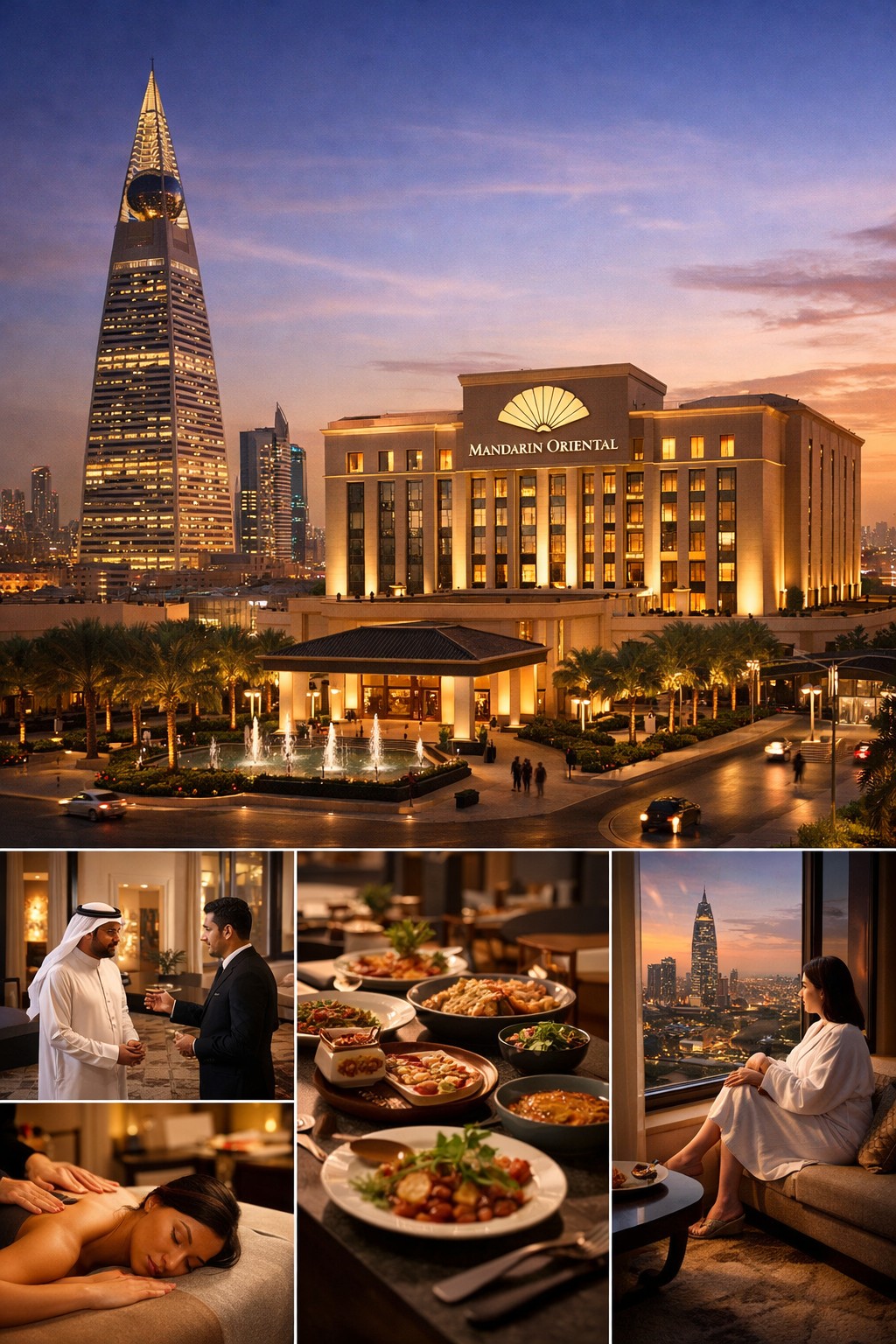
Mandarin Oriental Al Faisaliah, Riyadh
A Human Story of Hospitality, Memory, and a City in Transition
Cities, like people, carry layers of memory. They evolve through moments of ambition, restraint, reinvention, and quiet continuity. Riyadh, the capital of Saudi Arabia, is a city that has long been misunderstood by outsiders and deeply cherished by those who know it well. Often perceived through the lens of politics, oil, or rapid modernization, Riyadh is also a city of human rhythms: morning traffic flowing toward offices, evening gatherings around shared meals, family celebrations, and personal aspirations unfolding behind closed doors. Within this living city stands Mandarin Oriental Al Faisaliah, a hotel that is not merely a place to stay, but a participant in the emotional and cultural life of Riyadh.
Mandarin Oriental Al Faisaliah occupies a rare position. It is both a witness to the city’s past and a symbol of its present transformation. Long before the name Mandarin Oriental became associated with the property, Al Faisaliah Hotel was already an icon. It hosted heads of state, business leaders, artists, families, and travelers who came to Riyadh during different chapters of the city’s development. Its walls absorbed countless conversations, decisions, celebrations, and moments of solitude. Today, under the Mandarin Oriental brand, the hotel does not erase that history. Instead, it listens to it, honors it, and gently reinterprets it for a new era.
To understand Mandarin Oriental Al Faisaliah, one must first understand Riyadh itself. Riyadh is not a city that reveals itself quickly. Its beauty is subtle, layered, and often private. It lives in courtyards rather than grand plazas, in hospitality extended behind doors rather than on open streets. The city has always valued dignity, discretion, and depth over spectacle. As Saudi Arabia enters a period of rapid social and economic change, Riyadh is learning to speak a new visual language, with modern architecture, cultural venues, and international influences. Yet its core values remain deeply rooted. Mandarin Oriental Al Faisaliah mirrors this duality. It is modern without being detached, luxurious without being loud, international without losing its local soul.
The first impression of the hotel is one of calm authority. It does not seek to impress through excess, but through balance. The architecture communicates confidence, stability, and continuity. Inside, the spaces feel deliberate and thoughtful. Light is carefully shaped. Materials are chosen not only for beauty, but for comfort and longevity. The atmosphere suggests that time moves slightly differently here, slower and more intentional, allowing guests to breathe, observe, and feel present.
Hospitality at Mandarin Oriental Al Faisaliah is rooted in attentiveness rather than performance. The staff do not merely execute tasks; they cultivate relationships. Many employees have worked at the property for years, even decades, and their sense of belonging is palpable. They remember returning guests, anticipate unspoken needs, and approach service with genuine care rather than scripted formality. In a city where personal connections carry deep significance, this human approach to hospitality resonates strongly.
For Saudi guests, the hotel is often not a destination but an extension of daily life. It is a place for important meetings, family celebrations, quiet meals, and moments of personal reflection. Weddings, anniversaries, and milestone events unfold within its spaces. For international visitors, the hotel serves as a gentle introduction to Riyadh. It offers comfort and familiarity while subtly guiding guests toward an understanding of local culture, etiquette, and values. In this way, the hotel becomes a cultural bridge, facilitating mutual respect and curiosity.
The rooms and suites at Mandarin Oriental Al Faisaliah are designed with a deep understanding of how people actually live and rest. Comfort here is not defined by extravagance alone, but by ease. Spaces feel intuitive. Lighting adapts to mood and time of day. Textures invite touch rather than admiration from a distance. The design avoids trends that age quickly, favoring timeless elegance that supports rest and mental clarity. For many guests, the room becomes a sanctuary, a place to retreat from the intensity of the city while still feeling connected to it.
Windows frame views of Riyadh that are both grounding and inspiring. The city stretches outward, a mix of tradition and ambition, old neighborhoods and rising towers. At night, the lights tell a quiet story of a city that rarely sleeps, not out of restlessness, but out of purpose. Watching Riyadh from the stillness of a hotel room offers a moment of perspective, reminding guests that they are part of a larger human narrative unfolding beyond their individual journeys.
Dining at Mandarin Oriental Al Faisaliah is an experience shaped by memory, craftsmanship, and cultural respect. Food in Saudi Arabia has always been about generosity and gathering. Meals are not rushed. They are moments of connection, storytelling, and shared presence. The hotel’s restaurants honor this philosophy while introducing global influences with sensitivity. Ingredients are treated with respect. Presentation enhances rather than distracts. Flavors are balanced, allowing each element to speak.
More than sustenance, dining here becomes an emotional experience. Business deals are discussed over coffee. Families mark special occasions around shared plates. Individuals dine alone, finding comfort in familiar rituals even when far from home. The hotel understands that food is deeply personal, and it approaches culinary hospitality as a form of care.
Wellness at Mandarin Oriental Al Faisaliah extends beyond the physical. The spa and wellness facilities are designed as spaces of restoration, where silence is not emptiness but presence. In a fast-changing city, these spaces offer stillness. Treatments draw on both global expertise and an intuitive understanding of the human need for balance. Guests leave not only relaxed, but recalibrated, reminded of the importance of caring for both body and mind.
What truly sets Mandarin Oriental Al Faisaliah apart is its emotional intelligence. The hotel understands that luxury today is not defined solely by material refinement, but by emotional safety. Guests want to feel understood, respected, and free to be themselves. The hotel provides this through subtle gestures: privacy when needed, warmth when welcomed, and adaptability to different cultural expectations. This emotional awareness is especially important in Riyadh, where hospitality is deeply intertwined with identity and honor.
The transformation of Al Faisaliah into a Mandarin Oriental property was not a reinvention, but a dialogue. It was a conversation between legacy and future, between local significance and global standards. The result is a hotel that feels authentic rather than imported. It does not impose a foreign identity onto Riyadh, but allows the city’s character to shape the guest experience. This respect for place is increasingly rare in global hospitality, and it gives Mandarin Oriental Al Faisaliah a quiet but powerful distinction.
As Saudi Arabia continues to open itself to the world, hotels like Mandarin Oriental Al Faisaliah play a crucial role. They become first impressions, cultural interpreters, and emotional anchors. They influence how visitors perceive the country and how locals experience change. By choosing thoughtfulness over spectacle, the hotel contributes to a narrative of Saudi Arabia that is nuanced, human, and deeply grounded.
In many ways, Mandarin Oriental Al Faisaliah is less about arrival and more about presence. It invites guests to slow down, to notice, and to engage with Riyadh not as a headline or a destination, but as a living city shaped by people. It reminds us that hospitality, at its best, is an act of listening. Listening to history, to culture, and to the quiet needs of those who pass through its doors.
In a world increasingly defined by speed and surface impressions, Mandarin Oriental Al Faisaliah stands as a reminder that true luxury is not about excess, but about meaning. It is about creating spaces where people feel seen, respected, and connected. It is about honoring the past while welcoming the future. And above all, it is about understanding that every journey, whether long or short, is ultimately a human one.